The Treaty Era
From 1855 to 1863, the United States government signed two treaties with the nimíipuu (Nez Perce) that dramatically reduced the nation's homeland. These agreements, pushed through in the rush to settle the American West, set the stage for conflict a generation later.
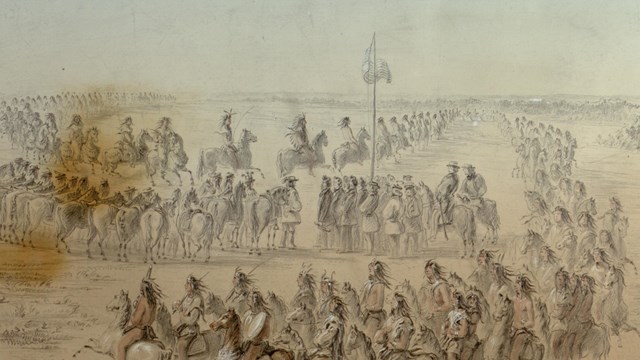
The Treaty of 1855
The discovery of gold and the Oregon Trail brought settlers flooding into the Pacific Northwest. Territorial Governor Isaac I. Stevens met with the nimíipuu and other tribes in 1855 to negotiate a settlement. After more than a week of tense discussions, the Nez Perce agreed to cede 7.5 million acres of tribal land.
In return, the nimíipuu kept the right to hunt and fish in their usual places. The Treaty of 1855 was ratified by the U.S. Senate in 1859. For a brief time, an uneasy peace held.
Gold and the Treaty of 1863
In 1860, gold was discovered inside the reservation boundaries. Rather than protect Nez Perce land from trespassers, the U.S. government instead initiated another treaty council — one designed to shrink the reservation by 90 percent and claim over five million acres. This time, the non-treaty bands refused to sign. Only 51 headmen from bands living within the proposed new boundaries affixed their marks to the document.
Despite this rejection, the U.S. Senate ratified the Treaty of 1863. The Nez Perce know it as the "Thief Treaty" or "Steal Treaty" because it was signed by only a fraction of the nation's leaders and took away the heart of their homeland.
The Road to Conflict
For fourteen years after 1863, the non-treaty bands refused to move to the smaller reservation. They held their ground in the Wallowa Valley and other traditional territories, defying the government's demand to relocate. In spring 1877, General Oliver Otis Howard arrived with an ultimatum: relocate in thirty days or face removal by force.
That deadline, and the refusal to grant it, sparked the conflict that would become known as the Nez Perce Flight of 1877.